

Hearing evaluations
An hour, a quiet room, and an actual answer.
A diagnostic hearing evaluation is not a screening and it is not the beep test at the doctor's office. It measures where your hearing sits across the whole frequency range, how well you make out speech, and what kind of loss — if any — is behind it.
What actually happens
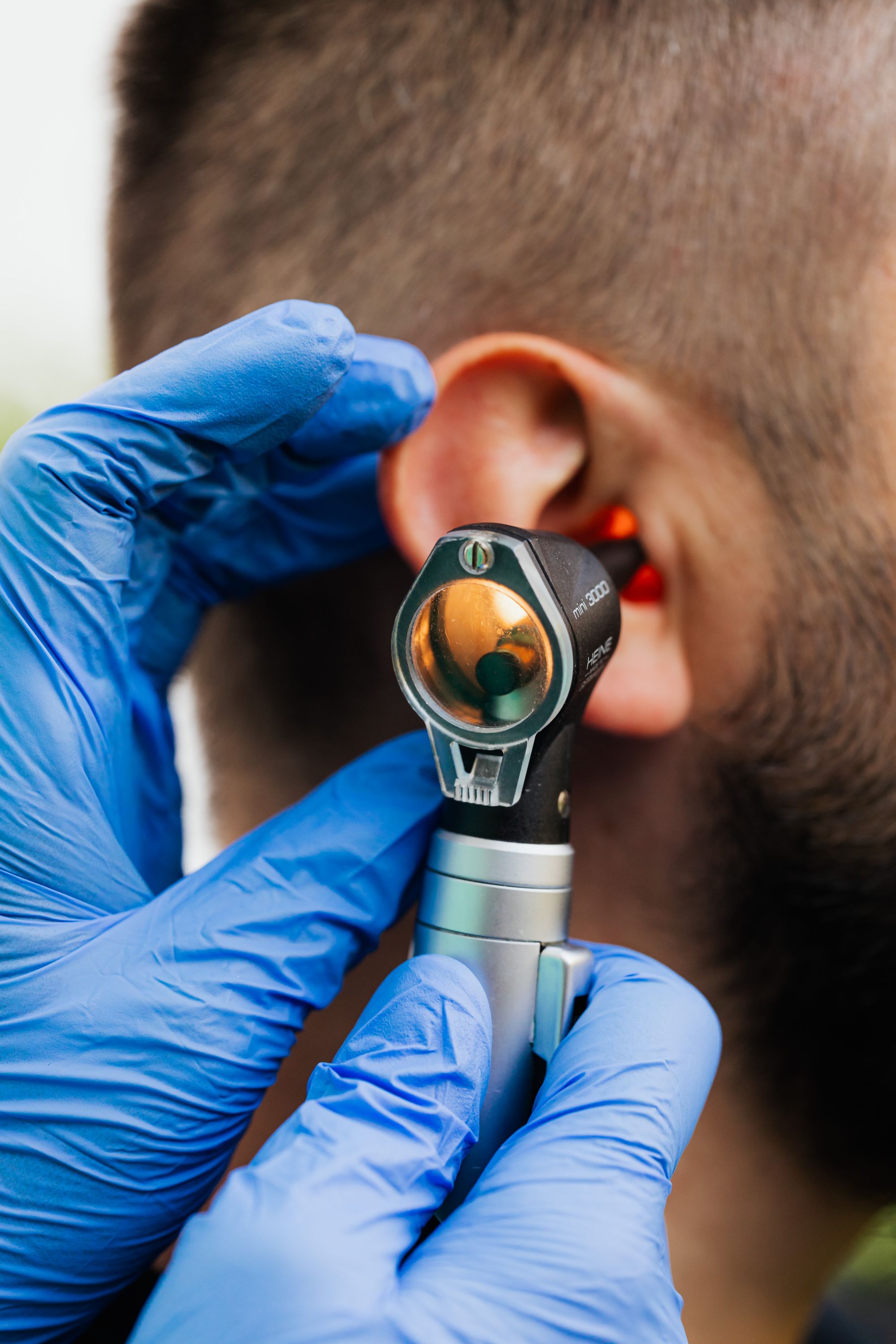
You sit in a sound-treated booth — the point of which is that the room stops being a variable. Dr. Loschen looks in your ears first, because a surprising number of hearing problems turn out to be wax, and that is a very good result to get.
Then the test itself. Tones are presented at each frequency from the low end of speech to the high end, quieter and quieter, until the softest level you can reliably detect is established. That is a threshold, and doing it across the range is what produces an audiogram. It is done twice — once through headphones, once through a small vibrator behind the ear — because the difference between those two results is what separates a problem in the outer or middle ear from one in the inner ear.
Then speech. You repeat words back at various volumes. This matters more than most people expect: two people can have identical audiograms and very different ability to make out words, and only the speech testing shows it. It is also the part that predicts how much a hearing aid will actually help.
What the result tells you
Two things: the degree of loss, and its type. Degree is how much — mild through profound, and it is normal for it to differ between ears and between frequencies. Type is where the problem is:
- Conductive — something in the outer or middle ear is stopping sound getting through. Wax, fluid, a perforation, a problem with the small bones. Often treatable, sometimes medically.
- Sensorineural — the inner ear or the auditory nerve. This is the common one: age, noise exposure, or both together. It does not come back, but it is very manageable.
- Mixed — both at once.
The reason this distinction matters is that it changes what happens next. Conductive findings can send you to a physician. Sensorineural findings start a conversation about whether and when amplification is worth it. An asymmetry between ears, or a sudden change, gets referred out the same day.
You do not have to want hearing aids
A common reason people avoid getting tested is the assumption that a test is the first step of a sales process. It is not. A significant share of evaluations at Island Hearing Services end with “your hearing is fine, come back in a year” — and having that on record is genuinely useful, because the most valuable audiogram is the one you can compare the next one against.
If you work around engines, saws, guns, or a band, a baseline is worth having in your thirties, not your seventies. Hearing conservation is the other half of that conversation.
Who should get tested
- Anyone who has been told, more than once, that they have the television up
- Anyone who follows conversation in a quiet room and loses it in a busy one
- Anyone with ringing in the ears — see tinnitus
- Anyone with regular noise exposure at work or at play
- Anyone over 60 who has not had a baseline done
- Anyone whose previous audiologist has closed and who is due for an annual
Come in and find out where you actually stand.
An hour in the booth and a conversation about what the results mean. Island Hearing Services is accepting new patients.
Rather not phone? Send a message and Dr. Loschen will write back.
Monday–Friday, 10:00am–5:00pm. By appointment.